
Technical Assistance Clearinghouse
A hub linking frontline communities, governments, and others with experienced, equity-focused technical assistance providers.
Purpose
The Community Retrofit Collaborative (CRC) operates at the intersection of housing, energy, health, and climate to support equitable, whole-home retrofit solutions. Across the country, communities are working to move beyond fragmented, single-measure programs toward integrated approaches that address both energy upgrades and critical home repairs, such as roofing, electrical, mold, and lead remediation, that are necessary to make homes safe, efficient, and climate-resilient.
A core component of this work is the Retrofit Navigator model. Retrofit Navigators provide end-to-end support to households, helping residents move from intake through project completion by coordinating scopes of work, braiding funding across programs, and ensuring projects advance affordability, health, and climate outcomes.
The CRC Technical Assistance Clearinghouse connects communities and governments to values-aligned technical assistance providers who can support equitable, community-driven building retrofit efforts.
Who Can Apply
The TA Clearinghouse is open to community-based organizations, local governments (such as housing staff), policy advocates, workforce partners, and others engaged in or supporting retrofit navigator programs.
Examples of who can apply:
City staff (housing, sustainability, climate/energy)
Community-based organizations (CBOs)
Organizations that already have elements of a Retrofit Navigator program and want to strengthen or scale it
Staff from energy resource hubs
Communities or governments that recently received major funding (e.g., CPRG) and are designing Retrofit Navigator programs from the ground up
Menu of TA Services
CRC technical assistance is delivered by experienced practitioners and organizations with demonstrated expertise in designing and implementing the full lifecycle of equitable retrofit programs. Partners are selected based on their track record in areas such as program design, community engagement, financing, and whole-home retrofit delivery. See the full list of partners here.
The services below reflect common areas of support and are adapted to local context through dialogue with community-based organizations, governments, and TA providers. Support may range from light-touch advisory to more in-depth, sustained engagement depending on partner needs.
Community Engagement & Partnership Building: Strengthen community–government collaboration, shared decision-making, and accountability structures (e.g., co-designing engagement processes with local CBOs)
Equity Analysis & Metrics: Map equity needs and build metrics that track emissions and outcomes like health, affordability, jobs, and resilience (e.g., prioritizing high energy-burden neighborhoods)
Building Stock & Market Analysis: Assess local building stock, energy/carbon impacts, readiness, and constraints to inform program/policy design (e.g., analyzing older multifamily retrofit needs)
Grid & Utility Impact Analysis: Analyze grid capacity and rate/bill impacts; align program design with utility incentives and data access (e.g., estimating electrification impacts on peak demand)
Affordable Housing & Tenant Impacts: Evaluate impacts on rents, housing availability, energy burden, and tenant protections to preserve affordability (e.g., assessing risk of rent increases from retrofits)
Workforce & Economic Impacts: Identify workforce gaps and contractor needs; assess job creation, job quality, and local economic impacts (e.g., evaluating contractor capacity gaps)
Policy & Program Design: Design/strengthen building performance policies, targets, timelines, and community-led governance approaches (e.g., developing locally tailored performance standards)
Implementation Support: Support compliance pathways, incentives, partnerships, and strategies for under-resourced buildings/owners (e.g., designing alternative compliance pathways)
Funding & Sustainability: Identify/align funding sources, stack incentives, and build equity-centered funding narratives for durability (e.g., layering federal and local funding sources)
Learning, Evaluation & Adaptation: Build feedback loops and community-informed evaluation to improve programs over time (e.g., incorporating resident feedback into program updates)
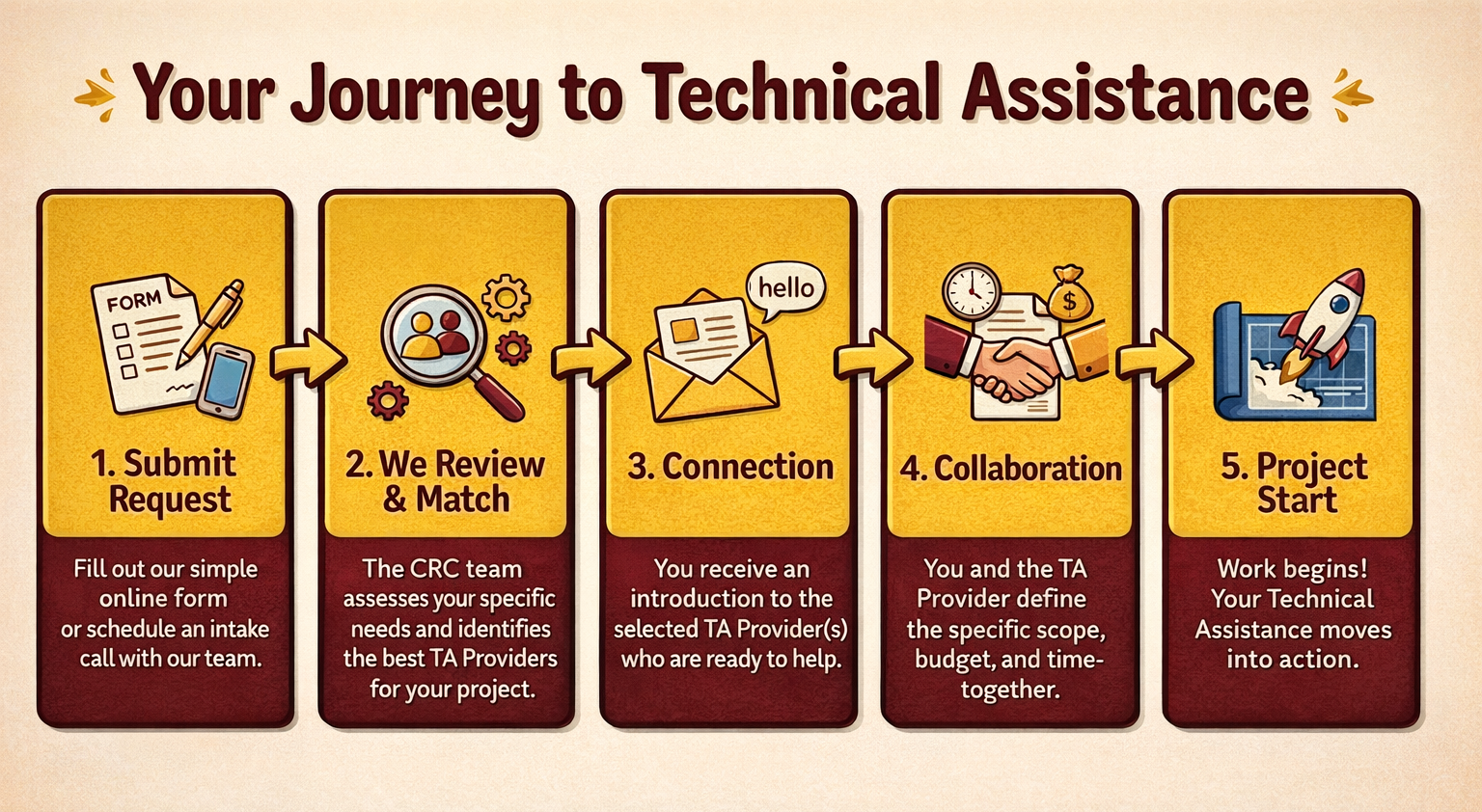
Your Journey to Technical Assistance
Submit: You fill out the simple Intake Request Form below.
Review & Match: We review your needs and may schedule a brief Intake Call to clarify scope and funding. We circulate your request to our Bench of partners to identify the best fit for your project.
Connect: We introduce you to a our Bench of TA Providers ready to help.
Collaborate: You and the TA Provider(s) define the scope, budget, and timeline together in order to finalize a contract.
Project Start: The work begins!
When helpful, we may also recommend other aligned initiatives providing relevant technical assistance to support clear lanes and collaboration across the field.
Important Note on Funding
Please read before submitting.
Resourcing Your Technical Assistance
The CRC Clearinghouse does not charge a fee to connect you to skilled TA providers. However, the provision of technical assistance itself is generally a paid engagement.
If you have funding: We will work to match you with TA provider(s) who fit your budget and scope.
If you need funding for technical assistance: Please submit a request and let us know. We capture data on "unfunded needs" to advocate for future resources, and we may be able to point you toward capacity-building grants or partners with subsidized availability.
Potential starting points: local foundations; funds within the city.
Contracting: In most cases, the requesting organization will contract directly with the TA provider.